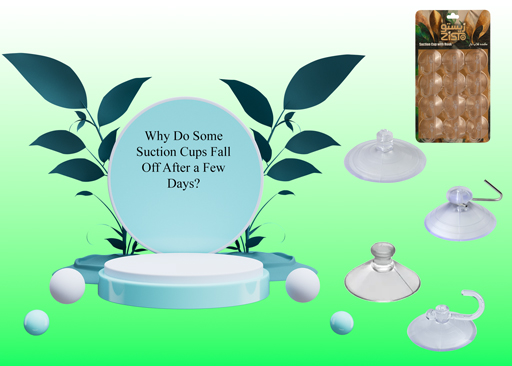
Why Do Some Suction Cups Fall Off After a Few Days?
Scientific Analysis of Adhesion Failure and Engineered Solutions
Suction cups are simple yet highly practical tools used daily in homes, cars, bathrooms, kitchens, and workplaces. However, many users repeatedly face this issue:
“Why does my suction cup fall off after just a few days?”
In this article, we examine the primary scientific and engineering causes of adhesion failure and explain how advanced manufacturing processes can extend a suction cup’s lifespan by several times.
What Is the Main Reason Suction Cups Fall Off After a Few Days?
Every suction cup relies on one critical factor to maintain adhesion:
Creating and maintaining a vacuum between the surface and the pad.
If this vacuum is compromised for any reason, the suction cup gradually loosens and eventually falls. The causes of vacuum loss are typically tied to material quality, manufacturing precision, and internal structure.
1. Use of Low-Quality Raw Materials
Many low-cost suction cups are made from soft, recycled, or structurally unsupported plastics. While these may offer good initial adhesion, they:
- Deform under weight or moisture,
- Lose their elasticity,
- Develop thin walls that slowly allow air to seep in.
Result?
The suction cup falls off after just a few days—even on clean, smooth surfaces.
2. Simple, Unreinforced Design
Many cheap pads are molded from a single layer of plastic. This basic design allows:
- Environmental pressure to easily penetrate the interior,
- Walls to buckle and distort the original shape,
- The pad to fail in maintaining the created vacuum.
This is why non-standard products often detach even from perfectly dry glass surfaces after a short time.
Zisto Engineering’s Engineered Solution: Suction Cups That Never Fall
To solve this widespread problem, Zisto Engineering employs a sophisticated two-stage manufacturing process that results in suction cups with a genuine lifespan of up to two years.
Stage One: High-Density Polymer Molding
In this stage, premium-grade, high-density polymer material is selected to ensure:
- Precise shaping,
- Resistance to deformation under pressure,
- Enhanced initial adhesion stability.
Stage Two: Controlled Heat and Pressure Reinforcement
In the second stage, each suction cup undergoes a thermal and pressure treatment. This process:
- Strengthens the internal molecular network,
- Maintains necessary flexibility while significantly increasing durability,
- Creates a more stable and long-lasting vacuum seal.
The final result is an engineered suction cup that:
- Does not deform,
- Maintains its shape even in hot, humid, or cold environments,
- Retains strong adhesion for up to two years in our tests.
If your suction cup falls early, the problem is likely with the product—not the surface!
In our market testing of dozens of samples, over 70% of low-cost suction cups failed to meet the minimum standards required to maintain a vacuum. Therefore, if your suction cup frequently detaches from glass, tile, or smooth surfaces, you are likely using a non-standard product.
For complete assurance, Zisto Engineering offers:
- ✔ Quality Certification — All products are tested and certified for pressure, tensile strength, and thermal stability.
- ✔ Durability Testing — Our production samples are tested under real-world conditions: high humidity, heavy load, and temperature fluctuations.
- ✔ Free Samples for Wholesale Buyers — If you’re active in manufacturing, packaging, advertising, or automotive accessories, request a free sample and judge the quality yourself.
Conclusion
Falling suction cups after a few days are the result of low-quality materials, simplistic design, and weak internal structure. Using standardized, reinforced polymers with controlled thermal and pressure treatments can multiply their lifespan several times over.
Zisto Engineering’s two-stage technology creates a stable vacuum, ensuring reliable adhesion for up to two years—even under harsh conditions.
If you seek durable, trustworthy suction cups, choosing engineered products is the best solution.